
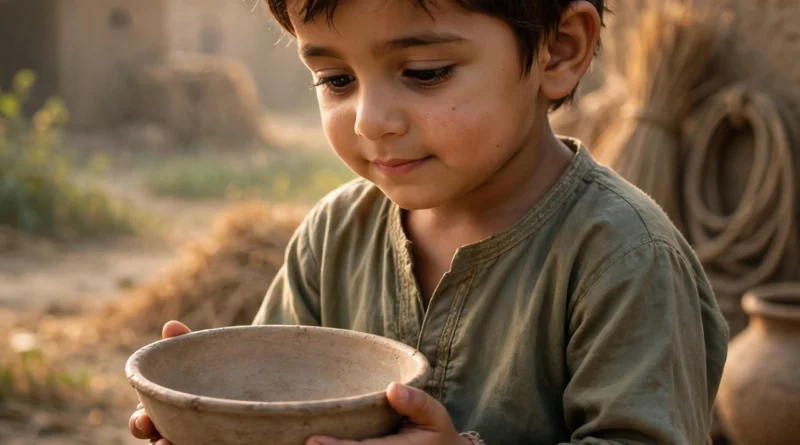
Hello, my lovely readers. How are you all doing today? I hope everyone is fine and eating well. Kal daftar se wapsi par rasta mein sabzi walay ne kaha — “Baji, tamatar 200 rupay kilo ho gaye hain!” Global Hunger Index 2026 ne Pakistan ko 122 mulkon mein 106 number par rakha hai, aur score 25.5 hai — matlab bhook ka masla “serious” hai. Ami ne kaha: “Beta, ye to hum roz mehsoos karte hain.” Dekhiye, mein health ka mahir nahi — bas aik aam Pakistani hoon jo roz bazaar ki qeematein dekhta hai. To aaiye, is report ko aasaan lafzon mein samajhte hain.
What Is the Global Hunger Index?
The Global Hunger Index 2026 Pakistan result is out, and it is not good news. Pakistan is ranked 106th out of 122 countries. The report was released earlier this week. It gives Pakistan a score of 25.5, which puts the country in the “serious” hunger category. Let me explain what this means in very simple words.
First, let us understand what this index is. The Global Hunger Index, or GHI, is a yearly report. It measures how much hunger exists in different countries. A higher score means more hunger. So a lower rank is better, and a higher rank is worse.

Three groups make this report together. They are Welthungerhilfe, a group at Ruhr University Bochum in Germany, and Helvetas, a Swiss group. This year’s theme is “No Security Without Food Security”. In simple words, they are saying: there can be no peace if people do not have enough food.
The index uses four things to measure hunger. I will explain each one in easy words below.
The Four Numbers Behind the Global Hunger Index 2026 Pakistan Score
The Global Hunger Index 2026 Pakistan score of 25.5 comes from four parts. Let us look at each part one by one.
First, undernourishment. This means the share of people who do not get enough food to eat. In Pakistan, 16.1% of the people are undernourished. That means about 1 in every 6 people does not get enough calories.
Next, child stunting. This means children under five who are too short for their age. This happens when children do not get good food for a long time. In Pakistan, 33.6% of small children are stunted. That means 1 in every 3 small children.
Then, child wasting. This means children under five who are too thin for their height. This shows short-term hunger. In Pakistan, 9.8% of small children are wasted. So about 1 in every 10 small children is too thin.
Finally, child mortality. This means the share of children who die before their fifth birthday. Poor food and bad health both play a part here. In Pakistan, the rate is 5.6%. So about 1 in every 18 children does not reach the age of five.
These four numbers together give Pakistan its score of 25.5. The index says scores from 20 to 34.9 mean “serious” hunger. So Pakistan sits firmly in the serious group. Full details are on the official report website.
How Does Pakistan Compare With Neighbours?
Now let us see how our neighbours are doing. This part is painful but important. Only Afghanistan is worse than Pakistan in South Asia. Afghanistan is ranked 108th with a score of 28.6.
Here is the full picture of South Asia:
- Sri Lanka is at 53rd place with a score of 10.2.
- Nepal is at 72nd place with a score of 14.5.
- Bangladesh is at 84th place with a score of 19.2.
- India is at 100th place with a score of 24.1.
- Pakistan is at 106th place with a score of 25.5.
- Afghanistan is at 108th place with a score of 28.6.
So Pakistan is the second-worst in South Asia. India, Bangladesh, Nepal, and Sri Lanka are all doing better than us. Only Afghanistan is below us.
The report also says something sad: Pakistan and Afghanistan are the only two South Asian countries where hunger has become worse since 2018.
Has It Become Worse Over Time?
This is a good question. The answer has two parts.
In the short term, yes, it has become worse. Pakistan’s score was 24.0 in 2018. Now it is 25.5 in 2026. That is a rise of about 6.3%. Remember, a higher score means more hunger. The report says this is because of money problems, rising food prices, and climate shocks like floods.
But in the long term, things have improved a lot. Back in the year 2000, Pakistan’s score was 36.2. Now it is 25.5. That is a big improvement over 26 years. Fewer children are dying now, and more children are growing well than before.
Also, there is some good news inside the numbers. Child stunting has fallen from 38.1% in 2018 to 33.6% now. And the child death rate has fallen from 6.8% to 5.6%. So some things are getting better. But undernourishment has risen from 10.9% to 16.1%. That is the main worry.
Why Is Hunger Rising in Pakistan?
The report gives three main reasons. First, the economy is not stable. When prices go up, poor families cannot buy enough food. We at Pak Unfiltered wrote earlier this week about weekly inflation and how food prices are hitting families.
Next, climate problems. Last year, heavy monsoon rains and floods hit more than 6 million people in Pakistan. The floods damaged crops and farms. When crops are damaged, food becomes less and prices go up.
Then, food inflation. Even before the floods, food prices were already rising fast. A separate UN-backed report said Pakistan is among the top 10 fragile nations where food insecurity is most concentrated. It also said about 11 million people in Pakistan face severe food insecurity. Out of these, 9.3 million are in “crisis” condition and 1.7 million are in “emergency” condition.
What Can We Learn From This?
This report is not just numbers. It is about real people: mothers who cannot feed their children well, and children who cannot grow strong because they do not get enough food.
The good news is that Pakistan knows how to improve. The long-term trend since 2000 shows real progress. But recent years have pushed things backward. Money problems and floods have hurt the poor the most.
The fix needs many things together: stable prices, better crops, clean water, and good health care for mothers and children. It also needs fair wheat prices and honest food policies. We wrote about the wheat fight in Sindh this week, where the government and millers are fighting over cheap wheat. These fights affect the food on your table.
For now, families should know the signs of poor nutrition in children. Health experts, including the World Health Organization, say that regular health check-ups, clean drinking water, and a varied diet can protect children. If you are worried about your child’s growth, please talk to a doctor.
That is all for today, my dear readers. This was a heavy topic, but it is important that we all know the truth. If you have any questions, please feel free to ask in the comments. You can also reach us anytime through our Contact Us page.
Take care, and eat well.


